
Height, parking and site conditions among concerns raised at community meeting on Murphy’s Law proposal
By MATTHEW STEPHENS
The latest community consultation meeting for a proposal to build an 11-storey mixed-use residential building on the Murphy’s Law site in the Beach raised questions about the timing of the new plan, which has increased in height from an earlier approved six storeys.
“You guys did mention the (City of Toronto) Mid-Rise Guidelines, but that was not approved by the city until December 2024. So, was there some lobbying or conversations with the developer-friendly Ford (Ontario Premier Doug Ford) government that clued you guys in that there were policy changes coming that were worth waiting for?” asked local resident and meeting attendee Adam Smith during the community feedback portion of the online consultation meeting on the night of Monday, Oct. 27.
At the virtual meeting, city planning staff were joined by developer Sud Group and Bousfields Inc.’s planning consultants and community engagement team on behalf of the developer, as well as Beaches-East York Councillor Brad Bradford, to discuss the latest changes to the development proposal at 1684, 1698, 1700 and 1702 Queen St. E. The site is situated on the northwest corner of Kingston Road and Queen Street East and is currently occupied by a protected heritage building that was most recently home to the Murphy’s Law Pub.
Some of the significant changes to the new plan since the initial 2022 proposal include an increased height from six to 11 storeys in what will now be a rental building, the closure of the adjacent laneway (Penny Lane) for a pedestrian connection, “townhouse” and “landscaping” features, retail space at grade, and the reopening of Murphy’s Law.
As part of the new proposal, the building will include 216 residential units, with two studio units, 71 two-bedroom units, 106 one-bedroom units, and 37 three-bedroom units, as well as 54 vehicular parking spaces and 240 bicycle parking spaces in a rental building.
“A Zoning By-Law Amendment Application for the site was approved in July 2022 for a six-storey building. But the project team revisited the proposal between 2022 and 2024. Due to market conditions, which have unfortunately made the approved condominium project unfeasible to build at six-storeys,” said Bousfields Inc. planning consultant David Morse during the presentation on behalf of the developer in an earlier part of the meeting.
“In addition to this, the project was revisited in response to some of the province’s direction and focus for new housing in areas that could accommodate growth.”
During city staff’s presentation at the meeting, City Planner Sean Guenther mentioned that the City of Toronto’s Mid-Rise Guidelines, which were updated in 2024, are currently being used to “guide their work” when looking at mid-rise development applications across the city. According to Toronto’s Mid-Rise Guidelines, mid-rise buildings are generally defined as any building that is five to 14 storeys.
In response to Smith’s question regarding prior knowledge of the latest updates to city guidelines and the province’s Building Faster Act, which allows increased building density, Morse said that Bousfields Inc. has taken part in ongoing studies to update the city’s Mid-Rise Guidelines since 2016.
“Yes, the new Mid-Rise Guidelines were approved in 2024, but the study for the new Mid-Rise Guidelines had been going on for more than three years before that. In fact, it had been studied since 2016 with an update before that, and there were evolving thoughts on rear transition, height of buildings, things like that,” said Morse.
“It wasn’t that we were tipped off, it was that we were part of the process and being consulted with the city about updating the Urban Design Guidelines. So, we took queue from those updates, we worked with city staff, and we tried to put together a proposal that met the city’s new Mid-Rise Guidelines. And then they were updated and released in late 2024.”
At the beginning of the meeting, Bradford addressed the technical issues that saw the initial online meeting cancelled on the evening of Monday, Oct. 6. “I want to acknowledge the technical issues that we had on the last meeting. There are a lot of folks who care passionately about this site and this proposal, and it’s so important that we’re all heard and that everyone gets an opportunity to engage and provide their input,” he said.
Among several public concerns, including building height, a drawn-out timeline since site acquisition, increased traffic, and a lack of site maintenance over the past years – many attendees at the meeting challenged Bousfield’s description of the site being “unfeasible” at six storeys, despite the previously approved building height.
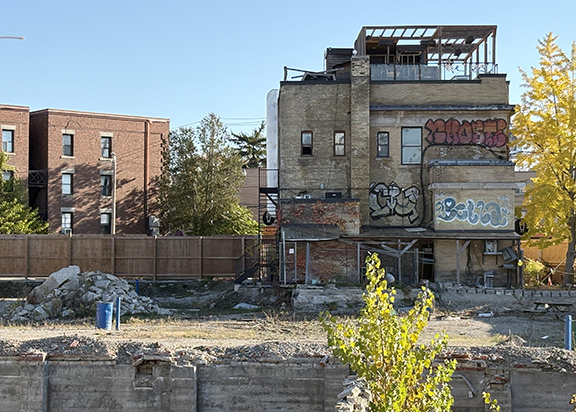
Another pressing concern amongst residents was that the site has remained unchanged since it was acquired back in 2022, apart from the demolition of several existing buildings, including the former Days Inn hotel.
During the community feedback segment of the meeting, several residents called out the current state of the site, complaining that the developer’s lack of maintenance has “depreciated” property values in the surrounding area for the last three years.
Morse said the existing buildings at the site in 2022 were demolished with “full intention” to build the six-storey building proposed in their initial application.
“In 2022, the world looked pretty different in terms of the market conditions, with the housing market for a condominium development versus one today, which is more conducive to a rental building development,” said Morse. “The site just wasn’t feasible to build at six storeys in the condominium model, and that sparked the need for the developer to move forward with something different.”
One attendee called out the proposal for transitioning from condos to rental units at the site, to which Morse said the developer couldn’t secure bank funding unless the site moved from condos to rental units as a result of “rising interest rates and land-holding values” in the condo market.
However, Smith said the city should implement legislation to ensure developers aren’t able to conduct demolition work on a site and then delay approved building projects for extended periods of time.
“What law or rule needs to change so that a developer cannot close a single business, or residence, or knock down a single usable building until they have enough buy-in to start building?” asked Smith.
In response, Toronto’s Manager of Community Planning Sarah Henstock informed attendees that city bylaw enforcement and legal representatives were not present at the meeting to answer questions regarding site acquisition and condition laws.
However, she said a property owner can seek to make changes to their proposal at any time during the application process.
“The way the planning act is structured is that an owner of a property can apply at any given time for an official plan amendment and/or rezoning for their property to change whatever the current permission is to something different,” said Henstock. “The city has no right to refuse the application coming in to us, but once we get an application, whether it’s something that was approved last year, 10 years ago, or anywhere in between – once we get an application, that starts this process of review.”
Prior to the meeting, some residents had expressed concerns that the height of the proposed building exceeded the six-storey limit established by the city as part of the Queen Street East Urban Design Guidelines, which were approved after extensive community consultation back in 2012. The Queen Street East UDG limits building heights along Queen Street East to six storeys between Coxwell Avenue and Nursewood Road in the Beach, and includes a number of design and architectural rules intended to preserve the area’s character.
Although concerns regarding the Queen Street East guidelines were not raised during the meeting, many residents of past meetings had expected the guidelines to apply to the Murphy’s Law proposal. During his presentation, Guenther told attendees that the city’s Mid-Rise guidelines would be used as the framework for assessing this proposal.
In regards to parking in the area, resident David Donnelly was confused to find that the number of parking spots on the site has decreased since the initial proposal, despite the new plan calling for a significant increase in height and the number of unit spaces.
“There is a shrinkage in parking down to 40 spaces, including visitor parking. The number of units has gone up from 90 to 216, yet the parking has gone down fractionally,” said Donnelly.
In his comments at the beginning of the meeting, Bradford was adamant that any development in Beach-East York would not be allowed to include new on-street permit parking permissions on existing streets in the area.
“I know there’s a lot of parking concerns with this, so I’ll just say this as a reminder: I do not and have never permitted any new developments in Beaches-East York to be eligible for permit parking,” said Bradford. “My philosophy is if you need parking, you need to secure it within the building. Whatever this application is and what it lands at, there will be no exception to that rule.”
Bousfield’s transportation consultant Robert Keele said the decision to minimize the amount of vehicle parking on the site was determined by a number of factors.
“In the City of Toronto, the bylaw actually has no minimum for resident parking. It actually has a maximum number of stalls that can be provided,” he said.
“And so, the intent behind doing that is to essentially have parking be driven by market demand. So, developers understand how much demand exists for parking. This is information that is developed through previous projects and what’s being approved in the area. And this allows us to provide an amount of parking that meets the market demand, meets the needs of future residents of this project without over-providing and potentially encouraging more people to drive, which is not the intent we want to achieve here.”
However, many residents still worry that the proposed building’s new residents, especially those occupying two and three-bedroom units, will arrive with vehicles and opt for parking in the surrounding area without permits.
Despite many attendees expressing concern about the updated proposal, longtime resident Janice Rushford voiced her approval for the project, mentioning that it could help to revitalize the area and serve as a building that could allow downsizing residents to remain within the Beach community.
“As long as I can remember growing up in the Beach, that corner has been a real eyesore, and I think what they’re proposing is the change that the corner really needs,” said Rushford. “Looking at the age demographic of the Beach – for the people who are downsizing, where are you downsizing to? When you live in the Beach, it’s not like we have a majority of bungalows or one-level residences where these people can go.”
In the next steps of this development proposal, the applicant will review public feedback before submitting a report with recommendations to Beaches-East York Community Council and then full Toronto Council, which will make the ultimate decision to either support or deny the application.
For more information regarding the project, please go to https://www.queenkingston.ca/
To submit any further questions to city staff regarding this proposal, send an email to info@queenkingston.ca, or reach out to Sean Guenther at Sean.guenther@toronto.ca


Comments (0)
There are no comments on this article.