
On The Wild Side: Some fascinating facts about spiders
By ANN AND ERIK BROKELMAN
The other day, my granddaughter Cara came to my house for a sleepover. She’s at that wonderful age where anything to do with animals sparks her interest, and lately she’s even been showing an interest in photography. You can imagine my joy and excitement over this!
Along with keeping an eye out for hawks, coyotes, foxes, and other wildlife, she and I set off to find bugs, katydids, and spiders.
We wandered through a local park, our eyes sweeping over leaves, branches, and every shadow in between. We were having a wonderful time when we came across the coolest spider I’ve ever seen.
It was around 7 p.m., and the air was just starting to cool down. We were watching the spider while it waited in the centre of its delicate web, motionless.
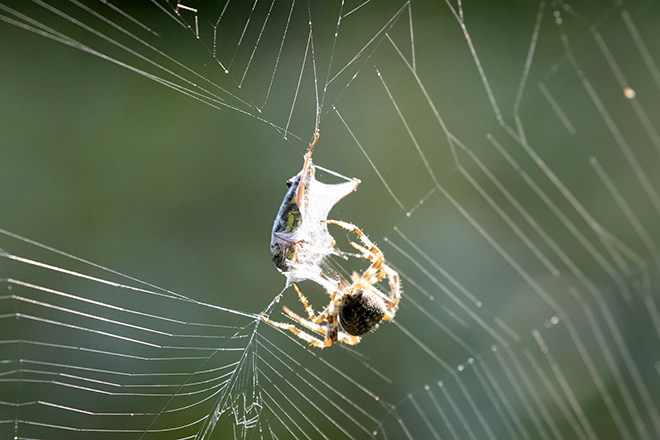
A wasp blundered right into the sticky threads, and, in an instant, the spider slipped to the web’s edge. I imagine their first instinct is to retreat, unsure whether the disturbance is from a predator or prey.
From what I’ve learned, a spider can read every tremor in its web like a signal. Once it knows something edible is trapped, it wastes no time. In a sudden blur of movement, this one darted forward and had the wasp right on top of it. I suspect the longer an insect struggles, the more likely it is to draw the attention of a bird or other predator that could put the spider in danger.
I had never seen this happen up close before, and Cara and I wasted no time snapping photo after photo.
The lighting was perfect as the spider began rolling the wasp in its web. The wasp struggled to break free, but there was no escape. Within minutes, it was completely wrapped, immobile, and secured. It’s so impressive, and a little terrifying. No wonder they make good monsters in horror stories.
We figured out that the spider was a female orb weaver, and we went home and did some reading to learn more. One article we found, from Ontario Nature, described orb weavers as “nature’s poster spiders.”
Their beautiful, spiralling webs are a perfect trap for insects. From start to finish, they can spin a web in about half an hour, using as much as 20 metres of silk and over a thousand tiny connections.
Amazingly, the spider itself can weigh over a thousand times more than the web it calls home. Every few days, sometimes even every day, the orb weaver will eat its old web and spin a fresh one, recycling most of the silk from the original web.
Now, I can’t say I was there millions of years ago to see this for myself, but it’s believed that early spiders first spun silk to protect their bodies and their eggs.
They would wrap their egg sacs in silk and may have even used the lines for a quick escape, like a rope dropping off a tree branch, if danger was near.
Over time, that same silk became a clever hunting tool, starting as simple ground webs and sticky traps, and eventually becoming the beautiful, intricate designs, we see in spider webs today.
Spiders make silk using a special organ called spinnerets, which are located right at the tip of their abdomen. These tiny, finger-like parts work like built-in spools, releasing silk threads.
Some spiders even have different kinds of spinnerets for different jobs, producing silk that can be sticky, strong, or stretchy, depending on what’s needed.
A couple of final fun facts: You probably know that spiders aren’t insects at all, they’re part of the arachnid family. But did you know that this group also includes scorpions, ticks, mites, and harvestmen (which are sometimes called daddy longlegs)?
One easy way to tell them apart from insects is by counting their legs: arachnids have eight, while insects only have six. Many spiders also have eight eyes, though some have fewer, and their eyesight can range from excellent to very poor depending on the species.
Enjoy the remaining days of summer, and if you see any cool spiders, let us know!

Thank you Joanne.
We are so lucky to have so much nature in the city.
Truly fascinating read! I always enjoy reading Ann’s columns. You never know what next she will write about. There is so much out there all around us, and we’re lucky she not only notices but encourages others to as well. Like her granddaughter Cara. Great start to what will no doubt be a lifelong passion as it is Ann’s!