Toronto’s Blue Flag beaches program lets swimmers know when it is safe to take a dip in Lake Ontario
By RYAN O’CONNOR
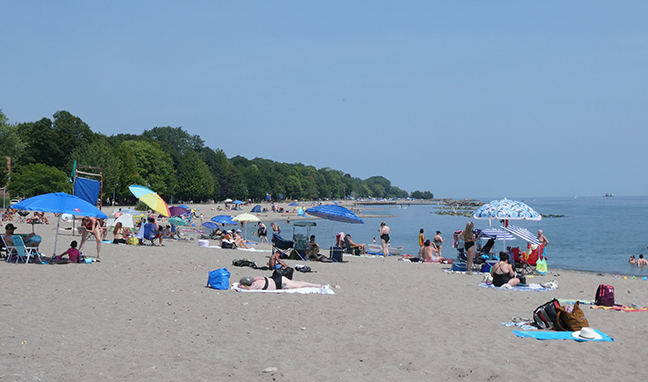
We all know the familiar ritual of a beach day on Lake Ontario. You find a spot, lay out a towel, pitch your umbrella and go to step out into the chilly water. As you step in, you hesitate. “This is Lake Ontario,” you say to yourself. “I might grow another foot if I dare wade deeper.”
Although Toronto is situated on the shores of one of the largest lakes in the world, many often opt to stay dry on a beach day out of fears of unknown water quality.
“I can’t risk it,” you conclude as you shy away from what would otherwise be a cool respite from the blaring summer sun and excessive heat. The stigma around Toronto’s Lake Ontario beaches, however, is just not true according to experts.
“Toronto generally has pretty good quality water at their beaches,” said Ian Young, an associate professor at the School of Occupational and Public Health at Toronto Metropolitan University.
“A few of our beaches have achieved Blue Flag Status, which signifies a safe water quality for a beach. It is updated annually, meaning we’ve reached sustainable cleanliness for years.”
Out of the seven beaches in Toronto that have achieved the Blue Flag status, many are situated in the east end of Toronto, including Woodbine, Kew/Balmy and Cherry beaches. The criteria for achieving this internationally recognized status includes water quality, environmental management, environmental education, and safety and services.
Toronto’s beaches benefit not only from their location underneath the naturally replenishing Oak Ridges Moraine, but also from extensive human efforts dedicated to maintaining their safety and environmental health.
For decades, restoration projects have been active throughout Toronto’s waterways, ensuring that these areas remain clean, safe, and accessible for the public.
Since the 1970s, which saw Lake Ontario at its peak pollution level, there have been various initiatives set up for science-backed ecological restorations.
“In the 2010s, the city conducted water testing at Kew Beach and found that its high E.coli levels were stemming from an abundance of birds nesting at its shores,” said Young. “Scientists implemented a bird management program and then a restoration program of the marsh in that area. They engineered a new berm to prevent runoff from the marsh into the beach water and redirected some of the drainage in the area as well. After that, the E.coli counts went way down.”
Controlling natural factors like bird nesting will play a significant role in securing the cleanliness of Toronto’s water as climate change heightens, and is just one example of a way scientists are working to keep local waters safe.
“We’ll be seeing more flooding in the coming years, which often causes urban runoff and wastewater seepage,” said Young. “Implementing more storm water management initiatives as heavy rainfall events begin to happen more frequently is something the city should be looking into.”
In addition to these measures, Young said that tracking pollution from its source is an example of an important measure Toronto can take in keeping the lake’s water clean.
“By analyzing the DNA of E. coli, researchers can trace pollution sources — whether from birds, human sewage, or other animals. This helps identify targeted solutions, like the bird management strategies used at Bluffers Park.”
He also said implementing rapid testing that has been utilized in other parts of the world can help keep things clean.
“We already have daily water sampling at Toronto’s beaches, which is rare in Ontario and even across Canada,” said Young. “But we could definitely benefit from more rapid testing. Right now, results generally take about 24 hours, so beach advisories are based on the previous day’s conditions. Water quality can change within hours.”
“There’s new molecular testing that can deliver results much quicker than the current system. Alberta and some U.S. cities like Chicago have started using it. If Toronto adopted this, we could sample in the morning and have same-day results by noon —giving the public a much more accurate picture of the day’s water conditions.”
While Toronto’s beaches generally maintain high water quality, it’s still best to check daily advisories before swimming. Though conditions can change rapidly, it is common for conditions to persist for 24 hours.
“Our Blue Flag beaches very occasionally will have higher levels of E.coli, so it’s always safe to check,” said Young. “Especially going to non-Blue Flag certified beaches like Marie Curtis or Sunnyside in West Toronto.”
While Toronto has long benefited from the relative safety of its shores, the health of the city’s waterfront is tied to broader environmental action. It will take a shared commitment from all levels of government and the public for the city to maintain its reputation as a safe beach community.
For more information on Toronto’s beaches and the Blue Flag program, please go to https://www.toronto.ca/explore-enjoy/parks-recreation/places-spaces/beaches-gardens-attractions/beaches/