
On The Wild Side: Snakes, squirrels and other wildlife encounters
By ANN AND ERIK BROKELMAN
This spring has been so full of nature moments that I couldn’t pick just one to focus on and write about. Instead, I’m sharing two quick stories that made an impact on me, starting with a surprise visit from a new scaly friend.
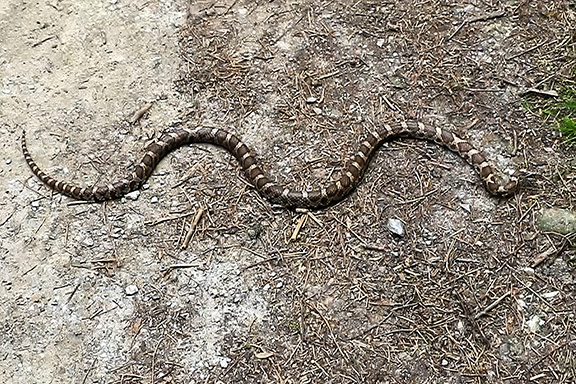
It all started with a call from my neighbours, Garry and Heather, who spotted a large snake in their front yard. They aren’t bothered by reptiles, but the size of this one had them both a little concerned that it might have been someone’s escaped pet.
I’ve always liked snakes, from a reasonable distance, and most of the bigger ones I’ve seen up close were at the zoo or the wildlife centre. This one, though, was at least three feet long, healthy, looked very ready to bite if it had to, and there wasn’t a nice piece of glass between us.
Not wanting to take any chances, I sent a photo to a couple of my go-to wildlife expert friends, Sarah and Andrew, and asked for their advice. Honestly, how did we ever survive before cell phones? Thankfully, the picture was clear enough that they quickly identified it as a native species, the Eastern Milk Snake (Lampropeltis triangulum triangulum), and said that it was unlikely to be someone’s lost pet.
The snake was only five houses away from the bluffs and a nearby wood lot, so we carefully relocated it to the edge of the forest. With a notable hiss goodbye, it slithered quickly into the tall grasses and disappeared from view.
Eastern Milk Snakes are the kind you probably want around your neighbourhood; They are non-venomous and eat rodents, playing an important role in the local ecosystem. Maybe with the rising rat population in Toronto, we’ll start seeing more of them.
Their markings are stunning, with rich patterns on both their back and belly. They lay eggs and leave them to hatch on their own, and can live up to 10 years.
They’re currently listed as a species of Special Concern in Ontario, meaning that they aren’t endangered but are at risk of becoming so.
Every reported sighting of them matters for population monitoring, so I submitted this encounter to OntarioNature.org.
Thanks again to Garry and Heather for the call. What a cool encounter!
Now for the second surprise of the season and one that feels like something out of a fantasy tale.
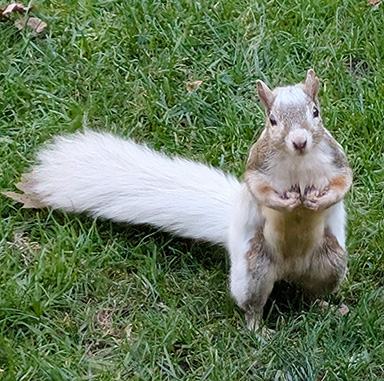
Jane Whitnall, a friend of mine, recently had an unusual backyard visitor: a striking Eastern Gray Squirrel with a white tail and a multicoloured coat.
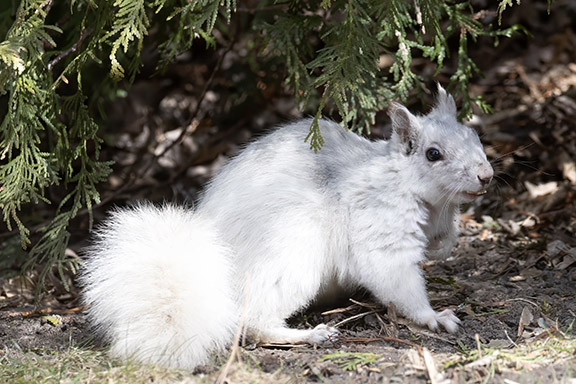
At first, Jane reported that she was just fascinated by its unique colouring. But then something quite unexpected happened: over five to six weeks, the critter completely changed colour! Though its eyes remained black, the rest of it, from head to tail, turned pure white.
Naturally, the big questions were: What? Really? No, really? How???
The important answer, I’ve learned, lies in something called leucism: a genetic condition that reduces pigment. It seems like humans can get a similar condition, but leucism, as a medical term, is reserved for animals.
It’s also different from albinism. Leucistic animals have a partial loss of colour, but their eyes remain dark, unlike Albino animals which lack pigment entirely, including in their eyes, which usually appear red or pink.
While we didn’t have a medical expert study it, this special squirrel had distinctly black eyes, and so leucism was the most likely explanation.
And let me tell you, seeing it in person was amazing! Jane kindly invited me over for a visit, and we watched the squirrel darting through trees and along hydro lines, full of energy and appearing absolutely dazzling in the sunlight. I’ve never seen another squirrel like it.
I’ve posted two photos: one from Jane showing the squirrel before it turned completely white, and one after. Thank you so much, Jane, for sharing this rare and beautiful backyard moment. It was unforgettable!


Thank you Ann for sharing these amazing wildlife stories—the snake is indeed a beauty and the squirrel, my goodness, its colour shift must’ve been a cool thing to witness!
I am into bug spider insect moth and butterflies. Walked into my office to see a butterfly flying in room. Red admiral and so cool .
Ann Brokelman – your articles are the best part of Beach Metro News – thank you
Thank you so much Ann
Loved your article on Garry & Heathers snake appearing on their front lawn – so good of your wildlife friend to help with identifying the background and it seems like you three did the right thing by taking it to a safe environment on the Scarborough Bluffs .
I have also seen one of those white squirrels at my friends on Lake St Clair in Windsor – so I found that article and the information you shared also very interesting – Isn’t life beautiful 🇨🇦Happy Canada Day from the west coast !
Thanks Christine