Scarborough Beach area residents asked to help honour Canada’s soccer history in advance of 2026 World Cup
By JOSH McGINNIS
In June 2026, soccer fans from around the world will descend on Toronto and other North American host cities for the FIFA World Cup and all the excitement that the international sporting event has to offer.
Beach resident Les Jones and the Soccer Hall of Fame Ontario is looking for a local resident or business to help honour the East Toronto area’s soccer history as part of the World Cup celebrations.
They are hoping to put up a plaque detailing the link between Canadian soccer history and the former Scarboro Beach Amusement Park. What they need is a local resident or business who is located on the site of the former amusement park and is willing to let the plaque be put up on their private property.
For soccer fans, this could be a once-in-a-lifetime opportunity to celebrate a unique piece of Toronto’s sporting past.
The plaque would be located somewhere within the original boundaries of the amusement park, stretching from Wineva Avenue to Scarborough Beach Boulevard and from Hubbard Boulevard to Queen Street East. According to local historian and Beach Metro Community News columnist Gene Domagala, the original entrance to the amusement park was located on Scarboro Beach Boulevard.
However, Jones said anyone willing to host a plaque in the general vicinity is encouraged to come forward. The former stadium grounds at Scarboro Beach Amusement Park ran west to east, from Wineva to Scarborough Beach Boulevard.
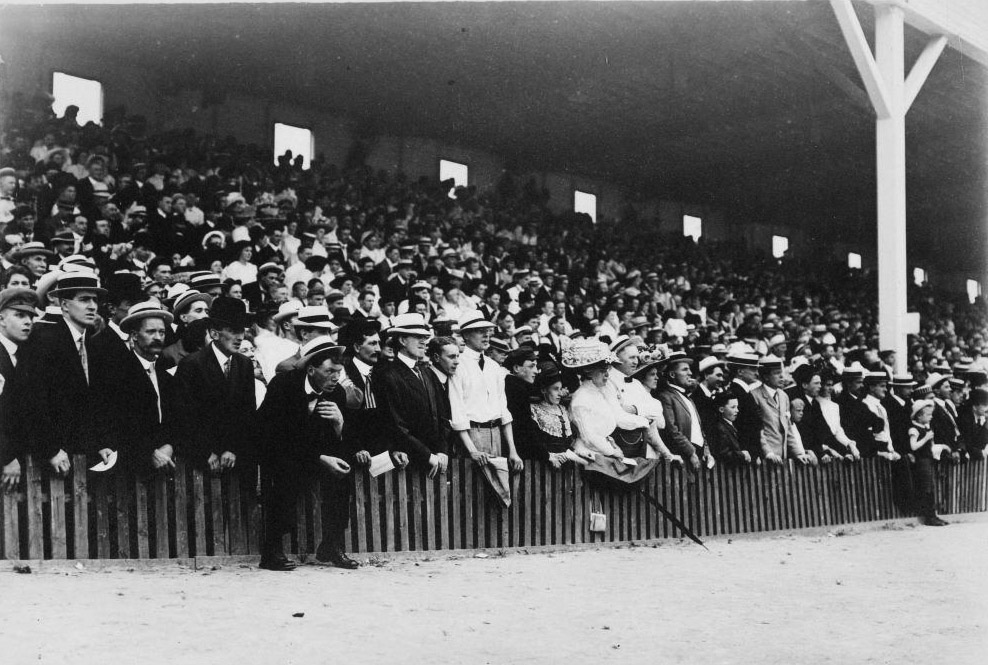
Jones said the athletic field in the park was once one of the largest event spaces in the city. The park hosted numerous sporting events, including several soccer games, before closing in 1925 to make way for residential development.
While the City of Toronto has accepted multiple applications for soccer-related heritage plaques in the lead up to the 2026 World Cup, Jones said Heritage Toronto is not currently seeking additional applications in this category.
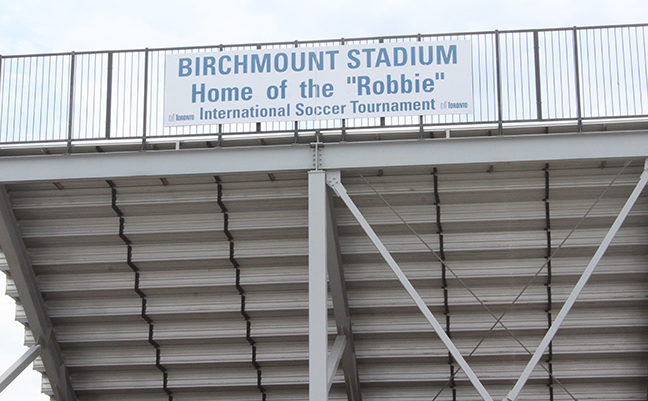
One of the accepted plaque applications is for Birchmount Stadium, commonly referred to as the “Home of the Robbie,” located at the intersection of Birchmount Road and Kingston Road.
The stadium is the traditional home to the annual Robbie International Soccer Tournament and Festival, which has been held since 1967 and features some of the best youth teams from across North America and the world. The Scarborough-based tournament, which also plays matches in East Toronto locations such as Cherry Beach, was established to raise money for cystic fibrosis research in Canada and has since raised more than $2 million for that cause.
Famed Canadian Band The Bare Naked Ladies even mentioned the tournament at the end of their hit song “One Week.”
A second location that has been accepted for consideration for a soccer heritage plaque is in Leslieville at the site of the former stadium known as Maple Leaf Stadium, commonly referred to as Ulster Stadium.
Established in 1925 by the Ulster United Football Club—widely known as the Red Handers—it featured a covered grandstand with seating for 10,800 spectators. Despite its prominence, financial difficulties led to the city’s takeover of the stadium property in 1942 due to unpaid taxes, and it was eventually sold and redeveloped into residential housing.
The Red Handers, formed in 1914, were once one of Canada’s premier soccer clubs. In Toronto, they were considered a force to be reckoned with, winning multiple Brigden Cups—Toronto’s coveted soccer trophy—in 1916, 1917 and 1920.
Once the City of Toronto approves these soccer plaque applications, Jones and the Soccer Hall of Fame of Ontario are seeking financial sponsorship to cover the cost of the plaques. The city does not cover those costs, said Jones.
“Toronto has a long and underappreciated history with soccer,” said Jones. “The first recorded match dates back to 1876 in Cabbagetown, we should honour its history in preparation for the World Cup.”
The Scarboro Beach Amusement Park opened in 1907. According to Jones, the stadium was a significant investment for the time, with construction costs estimated at $760,000 — roughly equivalent to $27 million today. The complex included a clubhouse, bleachers, grandstand, press box and a velodrome used for training and competition.
Jones said that in 1910, the site hosted the Canadian soccer championship final. The championship was contested between Calgary and Hamilton.
“With the World Cup coming in 2026, we want to honour the many important soccer moments in Toronto’s past,” he said. “We’re hoping to mark those with plaques, and potentially a time capsule filled with old soccer gear and memorabilia.”
The featured plaque that Jones hopes a local resident will host is expected to include key dates, significant events, and details on notable soccer matches played at the former Scarboro Beach Amusement Park.
Toronto’s soccer history dates back to the late 1800s, when the first organized club, the Toronto Football Club, was established, reflecting the sport’s original European title. The term “soccer” — originally slang coined at Oxford University — gained popularity in North America as gridiron football rose in prominence.
In recent decades, soccer’s popularity in Canada has surged.
The Canadian women’s national team has emerged as a global contender, having appeared in eight of nine FIFA Women’s World Cups and won gold at the 2020 Tokyo Olympics.
On the men’s side, Canadian players like Alphonso Davies and Jonathan David have found success in top European leagues and the Canadian men’s team competed in the most recent World Cup in 2022.
“A lot of great players have come through Canada because of our soccer academies and strong development programs,” said Jones. “Canada’s future in the world of soccer is only rising. Right now, it’s the country’s golden generation.”
If you are interested in hosting the Scarborough Beach Amusement Park soccer plaque or contributing to the costs, you can reach out to Jones directly by emailing soccerhistory@icloud.com