City seeks to register former Birch Cliff bank building as culturally significant under the Ontario Heritage Act
By MATTHEW STEPHENS
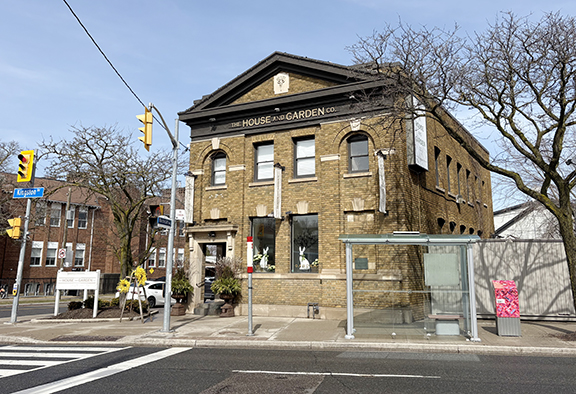
A former bank and municipal building at the corner of Kingston Road and Birchcliff Avenue in Scarborough is set to be registered as a property of cultural heritage by the City of Toronto.
The city is planning to register the building as a “property of cultural heritage value or interest” under the Ontario Heritage Act.
Located on the northeast corner of the intersection, the property is being recognized for its significance as an “historic commercial core of the former village of Birch Cliff.”
According to the City of Toronto’s Notice of Intention to Designate the Property, the structure is one of the last remaining early institutional and commercial buildings within the historic core of the Birch Cliff, which spans along Kingston Road from Valhalla Boulevard to Birchmount Road.
Built in 1921-1922 for the Bank of Commerce (now C.I.B.C.), the property includes a two-storey brick-clad and stone-detailed building designed in the neoclassical architectural style.
According to city documentation, the building’s architecture was designed by V.D. Horsburgh, who implemented his designs for several branch locations across Canada.
The structure has since had its interior revitalized as a retail space on the first floor, and as a living space on the second floor. The historical landmark property serves as a reflective example of a timeless classical style from the early 20th century, said the city.
The building’s design features a sense of architectural symmetry, with a roofline parapet and pediment above a broad cornice, and formal doorway surrounds with bold entablatures. Complementing features include window keystones, rounded windows and brickwork that forms pilasters, said the city.
Design materials include premium materials such as tapestry brick cladding the structure, with smoothly dressed stone used for the detailing. The caduceus plaque in the pediment of the structure features a staff with serpents, intended to symbolize commerce.
The property’s interior is illuminated with natural light from the large windows on each of its three street-facing sides, which highlights its classic original architectural features such as plaster mouldings, vibrant oak hardwood flooring, and a historically preserved tellers counter in the front of what is now a manager’s office. On the second floor, which has been reimagined as a loft, includes a kitchen, washroom, open concept living or workspace, and a spiral staircase leading to a rooftop which offers a view of Lake Ontario.
The building operated as a bank and council chamber from 1922 to 2003 on the first floor, and as a seat of Scarborough township council between 1922 and 1949.
Apart from its architectural design, the building derives much of its historical value from the institutional role it played in municipal governance for the Township of Scarborough for more than a quarter century.
During its local government use, members of municipal departments operated out of the building between the 1930s and mid 1940s.
In the early 20th century, the Birch Cliff neighbourhood in Toronto was once a small settlement (of the same name) within the Township of Scarborough. The settlement originated with the establishment of a post office and general goods store in 1907 at what is now the intersection of Kingston Road and Birchmount Avenue, just three blocks east of the historic landmark at 1660 Kingston Rd.
Prior to the establishment of the Birch Cliff settlement, the lands were used as cottage land for Torontonians living in the city’s core. With the construction of the street railway extension along Kingston Road to Midland Avenue in 1901, the area developed into a part of the Township of Scarboro the Birch Cliff settlement.
The former Bank of Commerce was erected at the centre of Birch Cliff’s commercial area, where it continues to serve as a historical landmark, said the city.
The city’s notice mentions that “the property at 1660 Kingston Road helps to constitute an intact early 20th century streetscape,” which serves as a “Distinctive component on Kingston Road, forming Birch Cliff’s main street.”
The property and building were first listed on the City of Toronto’s Heritage Register back in 2006.
For more information regarding the city’s notice to designate the property under the Ontario Heritage Act, please go to https://www.toronto.ca/legdocs/mmis/2025/pb/bgrd/backgroundfile-252577.pdf