East Toronto Baroque orchestra celebrates the joys of making music together

By LI HO
A community Baroque orchestra has been taking shape in the East Toronto area since the fall, offering a unique opportunity for musicians to connect with their craft.
Comprising individuals from diverse backgrounds, the group is recreating the music of the 17th and 18th centuries in an environment where players can rediscover the joy of making music together – much like the communal spirit that defined the Baroque era itself.
The idea came to Jane Ubertino, a retired elementary school teacher and trained cellist, about a year ago.
She envisioned a space where musicians could collaborate and explore this rich and historic genre without pressure. She proposed her idea to Kerri McGonigle, a professional cellist who specializes in Baroque music, who saw the potential and now conducts the group.
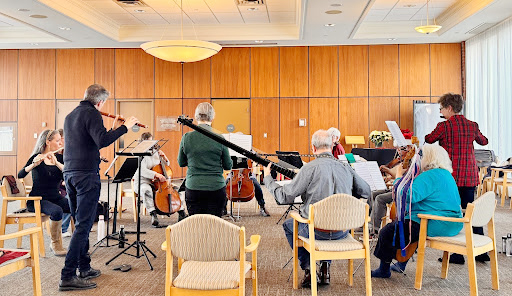
Their bi-weekly rehearsals take place at Chester Village, a long-term care home at Warden and Danforth avenues, which provides a bright, generous space for the group to practise while bringing music directly to the seniors living there. When Beach Metro Community News dropped in to meet with the musicians, the beautiful sound of their instruments filled the hallways.
During rehearsals, the musicians sit in a circle, rather than in sections, affirming the inclusion of every member. The atmosphere they create is relaxed and collaborative.
“This is a safe place to make all kinds of mistakes,” said Ubertino, rather than “a source of duress.”
McGonigle’s calm and patient approach means that she is leading by example. “For me, it’s very much coming from repairing some of the trauma that we’ve all had around music. It is much more common than we acknowledge.”
The musicians point out that traditional teaching methods can create fear and inhibit creativity, especially true when many begin learning music at a very young age.
“We are breaking down a lot of different barriers,” said McGonigle.
John Clark, who plays the violin, said, “We take two deep breaths before we start a piece. We care about the music and the historical performance, but mainly we enjoy making music together, so the spirit is what matters.”
For Jessica Kilmer, being part of this ensemble is a chance to connect with her violin. She finds that the relaxed environment is “eye-opening” and allows her time to explore her instrument and enjoy the learning process, free from the pressure of being technically perfect.
“It’s a place to discover how to create the sound we’re aiming for,” said Kilmer.
The members of the orchestra play both modern and Baroque instruments. At the moment, these include the cello, bass, violin, viola, viola da gamba, flute, oboe, recorder and the theorbo. They are exploring the possibility of adding a virginal, an instrument belonging to the harpsichord family.
According to Clark, “the harpsichord was the primary keyboard instrument of that era, differing from a piano in that the strings are plucked rather than being struck with a hammer.”
They play at modern pitch during the first half of their rehearsals, and dedicate the second half to playing at the lower Baroque pitch. “It’s going back to how it would have been played,” said McGonigle. “The instruments never needed to fill a big concert hall.”
Clark compared Baroque music, such as Handel’s Messiah, to the works of later composers such as Mozart and Beethoven. “The difference instantly leaps out at you. It translates into a different style of playing, a different kind of aesthetic. It’s not quite as operatic, it’s more conversational.”
To him, the ensemble is akin to having “a small, civilized conversation among players who know and trust each other.”
Their members range in age from their 30s to their 70s. McGonigle emphasized that the goal is to make the group accessible to all levels, ensuring it remains a space where creativity and self-compassion can flourish.
Kilmer agreed. “The spirit of baroque is being accessible to everyone,” she said. “When you think about singing hymns in church, everyone can do that. It’s not elitist.”
Ubertino hopes the orchestra will continue to grow, “giving people who may not be professional musicians the opportunity to move forward with the Baroque style of music.”
“Even if you don’t have an instrument from that time, you can learn the style,” said McGonigle.
In addition to performing for residents of Chester Village, performances for the residents’ friends and family as well as the larger community are planned for late spring. For more information on the orchestra, please contact Ubertino at holdfastlucindajane@gmail.com
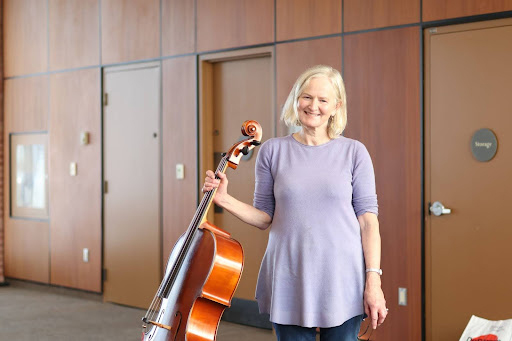
group’s rehearsal space at Chester Village in Scarborough. Photo by Li Ho.