In My Opinion: The case for the Woodbine bike lanes in wake of provincial government’s decision on other Toronto streets
By ADAM SMITH
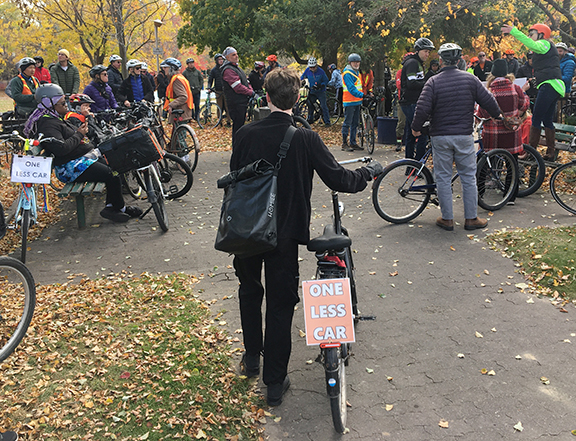
On the sunny Sunday afternoon of Nov 3, Beaches-East York MPP Mary-Margaret McMahon held a rally at Main Square protesting the proposed legislation by Ontario Premier Doug Ford’s government to unilaterally remove bike lanes from Toronto streets and dictate the conditions under which a bike lane can be installed.
Around 70 participants cycled from Main Square, travelling west to Coxwell Avenue, turning east to then stop at East Lynn Park, and back to Main Square.
Ford intends to impose the removal of all or part of the Bloor, University, and Yonge bike lanes, continuing his late brother Mayor Rob Ford’s tradition of further dismantling Toronto’s already disjointed and piecemeal cycling network.
While the Woodbine and Danforth bike lanes are to be left intact for the moment, they are an ongoing bone of contention with locals, and the calls to remove them have not relented in the seven years since the Woodbine lanes went in.
The short-sighted rationale of locals who wish to tear out the Woodbine bike lanes has never changed, nor have the unsubstantiated claims of lack of use abated.
The only reasons ever given to remove the Woodbine Avenue bike lanes are to make room for more car traffic and to disincentivize the use of side streets for northbound cut-through traffic between Corley Avenue and Gerrard Street East.
The changes to the Woodbine bike lanes in 2021, by narrowing the lanes and restricting parking during rush hour, has achieved all that can be done for the latter, but the former persists without any consideration of why Woodbine Avenue was the only viable choice for a north-south bike lane in Beaches-East York.
Critics cite many seemingly logical but ultimately specious reasons why Woodbine is unsuitable for bike lanes, from the loss of an arterial road, to winter conditions, to lack of use, to the fact it has a hill, to the viability of other routes. None of which hold water upon closer inspection and only reveal that the vast majority of these critics have never attempted to bike on Woodbine Avenue nor bike anywhere at all.
Woodbine Avenue is the only north-south road in Beaches-East York without streetcar tracks that fully connects Lake Shore Boulevard East to O’Connor Drive, and connects to four east-west bike routes in the process: Dundas, Danforth, Cosburn, and indirectly to the Martin Goodman Trail.
Any farther east and those connections cannot be made. Some have suggested Coxwell Avenue should have had the bike lanes, but the streetcar tracks from Gerrard down to Queen Street East would mean the permanent loss of street parking, not to mention running bike lanes parallel to streetcar tracks is never ideal, especially on such a relatively narrow street.
Coxwell Avenue is also too close to the Greenwood Avenue bike lanes, which from a network perspective would leave the centre of Beaches-East York bereft of a north-south bike route and make either Coxwell or Greenwood needlessly redundant.
Perhaps the most strange assertion is that Woodbine Avenue is not appropriate for a bike lane simply because it has a hill. This is just the topography of Toronto, by that logic Toronto would never have any north-south bike routes merely because Toronto happens to slope uphill as you go farther north.
While not even seasoned cyclists relish having to bike uphill, that is just the reality of Toronto’s geography, in particular as Queen Street East and Kingston Road is the beginning of what becomes the Scarborough Bluffs and the streets just get steeper and steeper the farther east you go.
The hill up Woodbine may seem daunting while sitting in a car, but it’s not nearly as steep as Southwood Drive for example. In a low gear it takes less than 10 minutes to cycle from Kingston Road to Danforth Avenue up that hill. And it gets easier every time you do it.
Anyone living right on Woodbine and being honest will begrudgingly attest that the use of the bike lanes has undeniably increased since their installation. Sure, they’re not even close to the bike traffic on Richmond or Adelaide streets downtown, and considering the lower density of the area they can never be expected to be, but it’s far more than there would be without them and it increases every year, especially Bike Share riders going to and from the beach.
The most encouraging sight is how often families with young children can now be seen using the bike lanes. I myself use them to bike my son to school at Norway Junior Public School.
An oft-trotted out reason against bike lanes in Toronto in general is the fact we have winter. Not only have bike lanes, and snow removal in bike lanes, made winter cycling more viable, a rare benefit of our warming climate is the increasing number of days one can safely winter cycle.
Last winter snowfalls never lasted more than three or four days before melting, ice on streets never got the chance to build up, and there were only a small handful of days where cycling was out of the question.
Winter cycling is increasing across the city and it’s a direct result of bike lanes and their maintenance.
There is one fact that can never be argued against however: that the Woodbine bike lanes constricted a once-arterial road.
The loss of two driving lanes has undoubtedly slowed traffic and increased car congestion.
But there is a simple solution to this in Coxwell Avenue.
Currently Coxwell has a patchwork of rush-hour parking restrictions that stymie the flow of traffic in the direction of rush hour.
Were these restrictions to be unified the whole length of Coxwell from Lake Shore Boulevard East to O’Connor Drive, the loss of Woodbine as an arterial route would be mitigated and traffic flow would greatly improve. Southbound street parking should be restricted from 7 to 9 a.m., and northbound from 4:30 to 6:30 p.m.
The timing could be adjusted as necessary, and would provide for an unimpeded and direct route for through traffic to get from O’Connor to Lake Shore and vice versa, replacing the lost volume on Woodbine.
There is also the call for bike lanes to be relegated to side streets, which is less applicable to Woodbine as it is to Danforth, as north of Danforth there are plentiful parallel routes. But this ignores the whole purpose of a bike lane: to get cyclists safely to their destinations.
Whether a car driver, transit rider, cyclist, or pedestrian, the vast majority of people’s destinations are on major avenues.
If bike lanes are primarily on side streets then they can never get a cyclist safely to their final destination on a major avenue.
A cycling network is not viable if it only protects cyclists on residential side streets that become little more than inefficient time-consuming detours and never takes cyclists where they actually need to go.
Any car driver who is wary of navigating a major avenue with cyclists weaving amongst cars to reach their final destinations should be in favour of separated bike lanes to keep bicycles out of their space.
Regardless of one’s views on bike lanes, Premier Ford’s latest legislation is just another example of provincial overreach and undemocratic interference with Toronto.
Premiers Mike Harris and Doug Ford both showed their disdain for democracy with their respective impositions of amalgamation and the mid-election halving of city council.
Harris filled in the Eglinton Avenue West tunnel just for Toronto to go dig it out again over a decade later to build the Crosstown LRT. And it’s not just the Ontario Progressive Conservatives! Under the Liberals and catering to 905 voters, Premier Kathleen Wynne denied Toronto much-needed revenues by preventing tolls on the Gardiner Expressway.
This is why Charter City Toronto was formed by a group led by former mayor John Sewell, so hopefully Toronto could become the master of its own affairs and gain some sovereignty free of provincial meddling.
In moving to a sustainable future Toronto needs as much multimodal transportation as possible, and a safe and highly connected cycling network is key to cycling as a viable mode of transportation.
We cannot expect cycling to pick up if we keep ripping out bike lanes in an already barely connected network.
While there are many glaring flaws to the highly inconsistent, confusing, and convoluted design of bike lanes in Toronto, and Woodbine and Danforth are no exception, that is no reason to toss them out completely. There are solutions to improving traffic flow without removing bike lanes, and there are ways to make Toronto’s bike lanes more intuitive and better integrated with car traffic.
All that said, bike lanes are not the biggest part of what we need to transition into a sustainable future.
The debate of the future of transportation is not cars versus bikes nor gas versus electric; it’s personal vehicles versus mass transportation.
And the most efficient non-car way to get around is a combination of bicycle and public transit. We can only hope for a future provincial government who understands that dynamic.