
Beach author Mary Ormsby tells the story of Ben Johnson, the ‘World’s Fastest Man*’
By DEBORAH McNORGAN
The Paris Olympics have ended but the sports scandals rage on, making a new book by Beach resident Mary Ormsby more timely than ever.
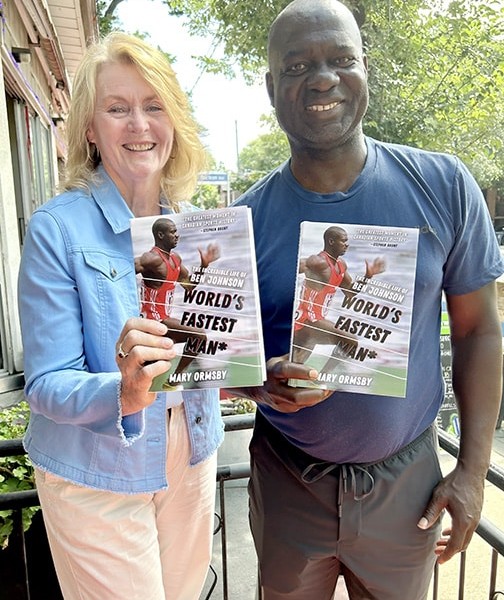
World’s Fastest Man* The Incredible Life of Ben Johnson tells the complete story of the Canadian athlete who on Sept. 24, 1988, won the 100-metre sprint in a world record 9.79 seconds at the Seoul Olympics – then lost it two days later after testing positive for steroid use.
Ormsby watched the saga unfold first-hand 36 years ago as a Toronto Star sports reporter in Seoul. She later spent a year covering the Dubin inquiry into the use of drugs and banned practices intended to increase athletic performance.
The documentary 9.79* inspired her to dig deeper into what happened to Johnson, who persuaded her to write the book she describes as a character study that’s part biography, part cold case.
“The book paints a picture that historical injustice occurred during that hearing in Seoul,” said Ormsby.
“If you’re a world anti-doping authority and you know or suspect historical injustice has occurred, and you do nothing about it, you’re enabling a system that is full of prejudice and discrimination.”
The 1988 sprint was described as “the dirtiest race in history,” with six of the eight competitors linked to doping.
Although Johnson later admitted to steroid use, the drug for which he tested positive was not the one he thought he was using. His drug screening was filled with irregularities and Olympic officials in Seoul withheld key evidence, circumstances that experts say denied him his right to due process and should have prevented his disqualification, according to the book.
“I’m hoping the reader will decide that this man was treated unfairly, and this case should be revisited,” said Ormsby.
“That’s quite separate from him later admitting that he used steroids…That complicates the story a little bit, but that’s what makes it such a compelling story, I think. Can you railroad a guilty man?”
Ormsby said it was when she saw Johnson’s drug test and supporting documents that she realized: “Wow, there’s lots of these unsigned handwritten scribbles on his drug test, at least one place that an athlete’s code was crossed out and his was handwritten in; there were doodles and calculations and all kinds of things that could have been challenged during his hearing in Seoul.”
She wondered whether he had been denied due process.
“Was he afforded every chance to defend himself fully and properly? That’s not the same thing as endorsing his behaviour, which is separate. He was cheating, we know that, yes, but he also had the right to a full hearing, as an Olympian and as a Canadian.”
Back then the media, herself included, didn’t challenge the International Olympic Committee or scientists the way they would today, said Ormsby, adding it wasn’t just the scandal but also
Johnson’s personal story that fascinated her.
The book describes how the young Jamaican-born Johnson became a sprinting superstar; and how the disgraced former athlete coached football star Diego Maradona and the son of a Libyan dictator while fighting to learn what happened in 1988.
Since that year, some things have improved in the world of sport, but much has not, said Ormsby. “Ben helped push change for better testing, better protection for athletes’ rights and better independence of the process. However, nothing has changed in many ways…
“Here we are 36 years after the fact, and athletes, even going into Paris, were cheating, being caught, being sanctioned. The World Antidoping Association is now feuding with American officials over tests involving Chinese swimmers. It’s getting really ugly. And it makes you wonder, what is happening? Will we ever rid sport of drugs? I’m not too sure we will. Maybe we need to amend the rules about what athletes use because they’re clearly still using a lot of drugs to get them through their training and into the elite level.”
There also seems to be a two-tiered level of justice, she said.
“If you happen to come from a powerful country that has officials that will go to bat for you, that’s hugely helpful. It’s the haves and have-nots in some way. It’s also important to point out that there are a lot of athletes out there who would never cheat. They are clean. And it’s really unfair to them when they see what is still happening: that you can have these performance-enhancing drugs in your system and some of those cheaters get punished, and some do not.”
While there are now rules regarding how athletes are given notice of allegations, and what the appeals process is, it’s time-consuming and expensive to pay for things like experts and accommodations for hearings, said Ormsby. And not everyone has their nation’s support.
Johnson was banned from competing for life and though he does individual training he is not allowed to coach anyone in Canada who belongs to an amateur sports body, which he said severely limits opportunities.
Johnson hopes the book will help clear his name and fix what he sees as serious flaws in the system.
“I was the only guilty one that they chose to pick on and everybody else got off scot-free,” he said in an interview. “I just want people to see me in a different light. I’m not going to take the blame for everybody else.”
Ormsby spent two years working on the book, much of it at the Beaches Branch Library.
She and Johnson still meet for breakfast at the Beacher Café on Queen Street East and he is routinely recognized, she said.
“If you walk down the street with him people will stop him. Even from their cars they’ll yell at him through the window ‘World’s Fastest Man!’”
Ormsby, a married mother of four, was born and raised in Scarborough, and she attended Senator O’Connor Catholic high school.
She played volleyball for The Ohio State University (OSU), graduated with a journalism degree, and is a member of the OSU Sports Hall of Fame. She played for the Canadian women’s junior and senior national volleyball teams.
From 1981 to 1985 she wrote for the Toronto Sun before moving to the Toronto Star, where she worked until 2020, in sports and on the investigative team. She was also a mid-morning host on TheFan 590. A Beach resident since 1996, she is a five-time National Newspaper Award nominee. The World’s Fastest Man* is her first book.