In My Opinion: Toronto Lakefront Community swims in support of the Rick Hansen Foundation and beach accessibility
By JANE ANDERSON
TORONTO LAKEFRONT COMMUNITY
As of Aug. 26, the Ripple Effect Charity Swim campaign has raised more than $4,000 for the Rick Hansen Foundation! The local advocacy group Toronto Lakefront Community (TLC) hosted a fundraiser throughout August in support of the Rick Hansen Foundation (RHF).
Most Canadians may be familiar with Rick Hansen’s 1985 Man in Motion World Tour, but may not be familiar with the foundation that was established in 1988, whose mission includes removing barriers to inclusion for people with disabilities.
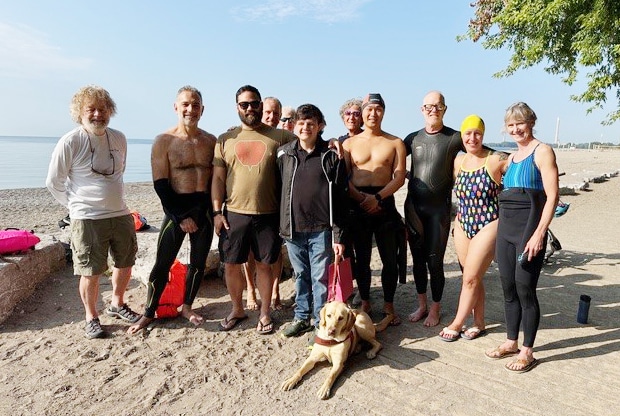
Over the past four weeks, our team of experienced, open-water swimmers swam at Cherry Beach, Centre Island, Woodbine, Kew-Balmy and Bluffers Park Beach, to both fundraise and to observe each beach’s accessibility features. Insightful feedback was provided by people with disabilities. Surprisingly none of these beaches currently provide access to the water, and there is limited access to the sand for people with disabilities.
On Saturday Aug. 24, RHF Ambassador Robert Hampson and his guide dog Kelly joined us at Kew-Balmy Beach.
Before we headed into the water for our latest fundraising swim Robert shared his experience. Blind since age four, Robert had to learn to adapt to daily living. He said that people with disabilities are always facing challenges, like proving to other people what they are capable of, and overcoming negative attitudinal barriers. At age eight, Robert swam two kilometres across the lake at camp with the help of a sighted guide. Soon Robert joined Variety Village where he was coached by Vicki Keith. He swam competitively for 17 years, winning medals at the provincial, national, and Paralympic levels.
Robert mentioned that one thing he enjoyed about swimming is the freedom of movement. He is not bound by the ground, or obstacles. Swimming seems to be universally beneficial and is an activity that can be enjoyed by people of all physical abilities.
Robert’s swimming success led him to embrace other activities. Today he downhill skis, rock climbs, waterskis, scuba dives, sails, tandem cycles, and curls. He has even tried skydiving and driving a race car. Trying new things allows him to be active and part of the community.
We were all inspired by Robert’s story. As passionate open-water swimmers we related to the joy that swimming brings us, and the camaraderie of our swim community here in the Beach.
That brings us to the issue of access to the water for persons with disabilities.
At Woodbine Beach we met a woman who used a wheelchair for mobility. She was an avid swimmer, and expressed disappointment that the current plastic mat did not extend to the water. She also had to turn her wheelchair around and go backwards onto the mat otherwise her wheels got stuck in the gap between the Boardwalk and the mat.
Another person, who was blind and used a white cane, found the joints between the plastic panels were bumpy and not cane-friendly. Because the plastic panels are not porous, the sand drifts away from the edges creating a lip which could be jarring or a tripping hazard for a blind person if they stepped down unexpectedly. As able-bodied people we often don’t think about the challenges a small thing like drifting sand might be for others.
At Centre Island beach we even had difficulty getting our beach cart onto the mat! Someone had to lift the back end. We discovered there is no beach wheelchair there, despite information to the contrary on the city’s website.
The City of Toronto is obviously committed to providing amenities that make our beaches accessible. However, we believe as a city we need to do better. Beaches claiming to be accessible need to be truly accessible.
We learned that RHF could be a resource for the City of Toronto and about alternative sources of funding for accessibility initiatives.
For example, there are federal, and provincial grants available, and organizations such as the Trillium Foundation, that can help fund projects in the community. The city does not have to bear the entire burden of the cost, and a small investment in the right tools will have many benefits.
While it’s ultimately up to the City of Toronto to implement solutions, it is useful to learn from the successes of other cities.
In Toronto, beach mats made from hard plastic non-recycled HDPE plastic panels are the norm. We have not found these used in other cities.
Every other city and municipality that we know of is using purpose-built, recycled plastic mats that come in rolls. This latter type of mat is wide and porous, allowing sand to filter through, resulting in less maintenance. The mats have colour contrasting edges and lines down the middle making them easier to navigate for people with low vision, and the lines are tactile so that blind people can independently follow the mats. They provide a smooth surface for easy access for people in wheelchairs, and most extend fully into the water.
Here is a link to a heart-warming story about a Canadian seaside town that recently installed accessibility mats: https://www.rickhansen.com/news-stories/blog/parksvilles-wave-inclusion
To arrive at the best and most effective solution we recommend the City of Toronto conduct focus groups that include members of the disability community.
Earlier this year TLC submitted a suggestion to the Standards and Program Development Department to assess alternatives, side by side with the current mats to arrive at an informed decision with appropriate public input. Let’s get this right.
According to RHF: “People with disabilities still face social and physical barriers that stop them from being a part of their communities. While we’ve made great strides towards creating an accessible and inclusive world, there’s still more work to be done”.
As Robert said, one small adaptation can make a huge difference in life.
We feel the same way, which is why our fundraising campaign was named The Ripple Effect Charity Swims. With every swim stroke we take, we imagine ripples of change.
For more information, please visit https://www.rickhansen.com/ or email TLC at info@tlfcommunity.ca or visit or fundraiser page https://www.canadahelps.org/en/charities/rick-hansen-foundation/p2p/Ripple-Effect/ or find the link on our website at https://www.tlfcommunity.ca/
All proceeds raised go directly to RHF general funds which support RHF initiatives across the country.
If you feel moved to do so please reach out to your city councillor to encourage positive change.