On The Wild Side: Spring turns thoughts to tulip trees and pollinators

By ANN BROKELMAN
Spring is here, which means it’s time for the first flowers to start showing. I think many of us will think of tulips as the iconic spring flower, but did you know that tulips also grow on trees?
Well, it’s not that they grow on trees, exactly, it’s that they ARE a type of tree. Maybe that’s confusing. Let’s start again: One of the most beautiful trees I’ve seen, at least around the Greater Toronto Area (GTA), is the tulip tree (Liriodendron Tulipifera).
You might be living near a tulip tree and not even know it, as it takes almost 15 years for them to mature, bud, and bloom. After that, the tree should produce them every year. As you can guess, this tree has flowers (see the photos) that resemble the flower we’re all more familiar with.
The trees bloom during the spring and summer, and they come in an amazing array of greens, oranges, and yellows. In the middle of the flower, you’ll find stamen that look remarkably like french fries. While many trees have their blooms higher up, my friend Livaline has one that flowers at eye level, which is perfect for photography.
If you’re wondering why I’m writing a story about a tree, instead of one of our wildlife neighbours as usual, I’ve had butterflies and pollination on the brain lately.
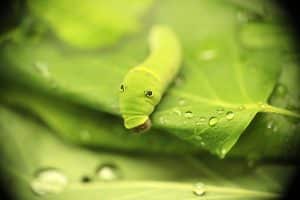
An Eastern Tiger Wwallowtail caterpillar eats a tulip tree leaf. Photo by Ann Brokelman.
I’ve recently been invited to visit a kindergarten classroom, at one of my granddaughter’s schools, and talk to them about the life cycle, metamorphosis, diet, etc…, of caterpillars, moths, and butterflies. While preparing for the presentation, I came across some information on tulip trees, and how they serve as an important pollinator to some of the butterflies the kindergarteners may be able to hatch.
While the tree’s near-abundant nectar and pollen also attracts hummingbirds, various species of bees, and other local pollinators, butterflies, and moths, notably the Eastern Tiger Swallowtail and the Promethea Silky Moth, also use the trees for laying their eggs; the leaves are a perfect meal for their caterpillars. If you ever see me standing by a tulip tree, without my camera in hand, odds are high that I’m inspecting the leaves looking for caterpillars and eggs.
On a different note, if you’re out and about on a spring hike, keep an eye out for a Jack in the Pulpit, (Arisaema triphyllum), which I’ve just recently become aware of myself. The Jack is a perennial plant, native to the woodlands of Eastern North America, it can be up to two feet tall, and it loves to grow in shady spots.

A Jack in the Pulpit, (Arisaema triphyllum) is shown in this photo. Photo by Ann Brokelman.
While highly toxic to us, (if ingested), they also attract a variety of pollinators. Two facts that make them notable, are that they have the ability to change their sex over the course of their 100-year life span! One season the plant may produce male flowers, but the next season they could grow female ones. Isn’t nature fantastic?
Enjoy the warmer air, and make sure you look not only up for birds, but down and around for some of our flowers, trees, and other amazing plants.