On The Wild Side: Eastern grey squirrel is more than grey and black

By ANN BROKELMAN
I spy, with my little eye, something that is gray, or black, or white, or brown, or piebald, or blond, or silver, or maybe even reddish. Can you guess?
Well, obviously it’s the eastern grey squirrel, (Sciurus carolinensis).
Because our fluffy tailed neighbour mostly appears in two colours, grey and black, many people think they are two distinct species.
While not a perfect analogy, think of them like black, chocolate, and golden Labradors: the same creature with no notable difference other than colour.
Like most animals, the varying colours are a result of genetic mutation, passed down from generation to generation, because they offered some sort of survival advantage.
Some colours gave them better camouflage, some make it easier to find a mate and reproduce, and sometimes, in cases like albinism/leucism, it just happens randomly.
I feel like I only used to see the two main colours, and now I’m seeing variety more often.
I’m not sure, however, if that’s because the other colours are becoming more common or if I’m just paying more attention.
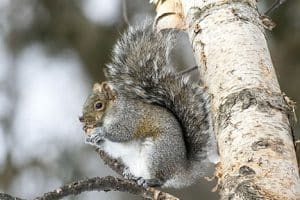
An eastern grey squirrel is shown above. Photo by Ann Brokelman.
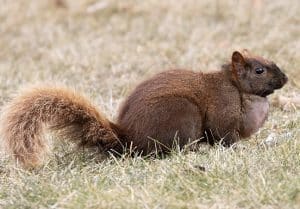
A reddish-brown squirrel is shown in the photo above. Photo by Ann Brokelman.
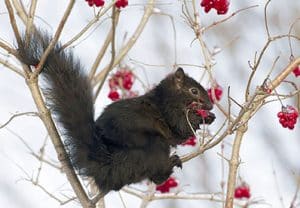
A black squirrel is shown eating berries in this photo. Photo by Ann Brokelman.
It wasn’t that long ago that I finally saw my first white squirrel, and I can’t express how excited I was.
What amazed me, though, was learning later that white squirrels are almost always white, not because of albinism as I thought, but because they have leucism.
To paraphrase what I’ve learned, from a couple online sources: leucism is when the animal is lacking many of its melanin pigment producing cells, while albinism is when the animal doesn’t have any of those pigments because it’s lacking a specific enzyme. It’s OK if you don’t quite understand, we can just chalk it up to ‘genetic magic’ and move on to enjoy looking at them.
If you’ve noticed our squirrels tend to be larger in the winter, it’s not just because they’ve fattened themselves up on nuts; they have thicker and longer fur in the winter for fairly obvious reasons.
Did you know that their tail has the important job of acting like a rudder when they jump from tree to tree?
The tail also helps keeps them warm in the winter, and they adorably use it as a blanket to wrap around themselves.
Perhaps most importantly, their tail can distract their predators, though they may lose it in the process. Better the tail than their life, of course.
One more fun fact for you: Squirrels can go up and down trees headfirst, quickly and gracefully, thanks to a special adaptation: their ankles/ wrists are hyper-flexible and can rotate a full 180 degrees.
The squirrel may be heading down the trunk, but its feet and claws actually keep pointing upward, enabling a speedy, but dexterous, descent. Amazing.
While most of us recognize the quick kuk-kuk-kuk-kuk scream of a grey squirrel, the next time you hear it, consider looking around for something bigger. As soon as I hear that sound, I know there’s a good chance that a predator is nearby, so I look around hoping to spot something like a fox, hawk, coyote, etc…
Have you seen any other interesting colours on squirrels? If the answer to the question is yes, will you please let me know.