Deadline to declare property’s occupancy status for Toronto’s Vacant Home Tax is Feb. 29
By AMARACHI AMADIKE, Local Journalism Initiative Reporter
The City of Toronto is urging homeowners to declare the status of their property within the next nine days. Property owners have until Thursday, Feb. 29 to declare occupancy status for the 2023 taxation year.
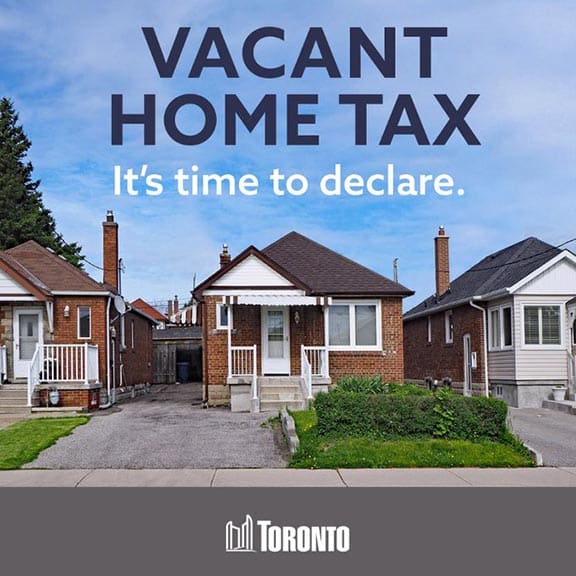
Through the Vacant Home Tax (VHT), the City of Toronto is hoping to increase housing supply by minimizing the number of unoccupied residential properties.
According to Mayor Olivia Chow, this can be achieved by taxing residential property owners who choose to keep their properties vacant.
“The Vacant Home Tax is one tool the city can use to address the issue of housing supply, by discouraging homeowners from letting their residential properties sit empty while so many people search for long-term accommodation,” said Chow in an earlier City of Toronto news release about the VHT.
The VHT applies only to properties that are unoccupied for a total of six months or more during the calendar year by the owner or tenant. However, some properties can be granted exemptions in special circumstances.
These include cases in which the registered owner is deceased; the principal resident is in care; the home is vacant for renovations and repairs; a court order prohibits occupancy for at least six months; or cases in which the property is required for employment purposes for a total of at least six months by an owner who lives outside the Greater Toronto Area.
A developer who has constructed a new building can also apply for exemption for up to two consecutive years.
Multi-residential, commercial and industrial properties, as well as properties classified by MPAC as vacant land, parking space or a condominium locker, are not required to declare occupancy status.
Those homeowners that are subject to the tax, however, will receive a Vacant Home Tax Notice at the end of March with payments expected in three installments between May and July.
Those who fail to submit their declaration of occupancy by the deadline will be charged a $21.24 fine.
“If homeowners choose to keep their properties vacant, they will pay a tax – with the revenues being used to fund affordable housing initiatives,” said Chow.
Although the VHT is expected to generate some revenue, a motion adopted at council on Oct. 11, 2023 stated that “the ultimate goal of the vacant home tax is to collect zero dollars”.
In the same meeting, Toronto councillors voted in favour of increasing the tax from one to three per cent of a property’s assessed value while requesting that Mayor Chow consider “directing a minimum of 10 million dollars of additional revenue” to the Multi-Unit Residential Acquisition (MURA) program–a program with an objective to protect Toronto’s current stock of affordable homes.
This MURA funding would be “generated from the increase in the Vacant Home Tax” and will become payable in 2025.
For more information on the Vacant Home Tax, visit https://www.toronto.ca/services-payments/property-taxes-utilities/vacant-home-tax/
To declare the status of your property, visit https://www.toronto.ca/services-payments/property-taxes-utilities/vacant-home-tax/vacant-home-tax-declaration-of-occupancy-status/
– Amarachi Amadike is a Local Journalism Initiative Reporter for Beach Metro Community News. His reporting is funded by the Government of Canada through its Local Journalism Initiative.