Beach author pens book on the battle to build the Luminous Veil suicide barrier on the Bloor Viaduct
By ERIN HORROCKS-POPE
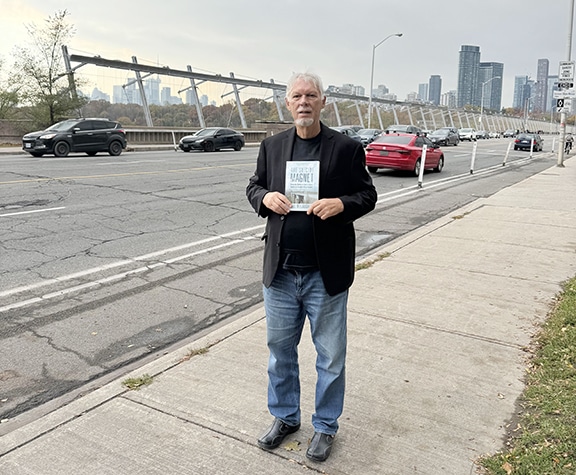
The Bloor Viaduct’s transformation from a haunting past to a symbol of hope takes centre stage in Paul McLaughlin’s latest work, The Suicide Magnet: Inside the Battle to Erect a Safety Barrier on Toronto’s Bloor Viaduct.
As an award-winning freelance writer, broadcaster, and teacher residing in the Beach since 1997, McLaughlin became the conduit for this narrative when his former student, Michael McCamus, approached him with the “untold story” of the Luminous Veil.
Built in 1918, the Prince Edward Viaduct (more commonly referred to as the Bloor Viaduct) harboured a dark legacy of being the second-most notorious suicide spot in North America (second only to the Golden Gate Bridge in California) before the installation of the life-saving Luminous Veil in 2003.
More than 400 lives had been lost to suicide from the bridge that spans the Don Valley from east to west and marks the transformation of Danforth Avenue to Bloor Street.
The sad reality that the bridge had been the site of so many deaths spurred a grassroots movement led by two ordinary citizens, Al Birney and Michael McCamus, who wanted to find a way to end the tragic count by having a suicide barrier erected. That barrier became the Luminous Veil.
McLaughlin’s involvement in chronicling these efforts was not born out of personal connection but from an external perspective when McCamus, a former journalism student of his at Ryerson (now Toronto Metropolitan University), approached him as the 20th anniversary of the Luminous Veil’s installation neared.
McLaughlin was captivated by the story of the viaduct, the campaign, and the ultimate transformation.
The campaign to install a suicide barrier gained significant momentum after Martin Kruze’s death in 1997. Kruze’s suicide was a response to the perceived leniency in the sentencing of his long-time abuser, part of the Maple Leaf Garden’s scandal. The tragedy, felt across Canada, brought national attention to the urgent need for a suicide prevention barrier on the viaduct.
The incident drove Birney and McCamus forward in their five-year-long struggle to convince the City of Toronto of the necessity for the Luminous Veil.
Reflecting on the significance of the bridge and its transformation, McLaughlin said, “The bridge and Luminous Veil are such an important part of the city’s history, both socially and politically.”
Statistics from the Government of Canada reveal that about 4,500 Canadians die by suicide each year. This serves as a reminder of the urgency to address mental health openly and comprehensively.
The Suicide Magnet not only recounts the historical battle for the suicide barrier but also serves as a call to action. McLaughlin emphasized the need for open discussions about suicide, challenging the existing taboos that many have around the subject.
Prior to writing the book, McLaughlin admitted the issue and the viaduct’s connection to it was not something that he thought much about.
“I was oblivious, as most people probably are, to the history of that incredible bridge,” he said, reflecting the widespread lack of awareness surrounding the viaduct’s dark past and emphasizing the life-saving impact of the Luminous Veil.
Anyone in crisis and contemplating suicide can get immediate help by calling the Suicide Crisis Helpline at 9-8-8.