
Reel Beach: History is a tale full of good and evil, triumph and treachery

By BERNIE FLETCHER
Our fair city is a favourite filming location for Hollywood movies, but it’s rare that “Toronto” ever gets any mention.
In Martin Scorsese’s Killers of the Flower Moon, Ernest Burkhart (Leonardo DiCaprio) tells his diabetic wife Mollie (Lily Gladstone) that she will be getting a new drug “all the way from Toronto” and she will be “one of the first five people in the world” to receive the new treatment.
This true story takes place in Oklahoma in the early 1920s during the “Reign of Terror” (1921-1926) when dozens of the oil-rich Osage Nation people died under mysterious circumstances, systematically murdered by white settlers in order to steal their oil “headrights.”
Scorsese turns the old “western” movie stereotypes on their head. The cowboys in white hats are the predatory wolves and coyotes.
The epic film is adapted from the gripping, non-fiction 2017 book by David Grann. While Grann spends much of his book detailing the early days of the Bureau of Investigation, Scorsese wanted to focus on the twisted relationship of Ernest and Mollie whose family was targeted.
In the early 1920s the world was recovering from war and pandemic. At the University of Toronto more than a thousand miles away from the oil rigs of the Osage Nation, Dr. Frederick Banting and his assistant Dr. Charles Best began researching a treatment for diabetes from pancreatic extract.
At the time a diagnosis of Type 1 diabetes (diabetes mellitus) meant a certain death. The only treatment was a starvation diet.
On Dec. 2, 1921, Harry Thompson of Pickering Street in the Upper Beach carried his emaciated, 13-year-old son, Leonard, into Toronto General Hospital. Leonard was near death, drifting in and out of a diabetic coma. His father was so desperate to save his son’s life that he agreed to let doctors inject Leonard with a new experimental drug.
The New Year of 1922 brought new hope to diabetics. On Jan. 11 Leonard became the first patient in the world to be treated with insulin (from the Latin root for “island”).
The first injection did not work, but Dr. J. B. Collip was able to purify the extract. On Jan. 23 Leonard received his second injection and his recovery was a miracle of science. He was able to lead a fairly normal life until his death in 1935. Leonard is buried in St. John’s Norway Cemetery.
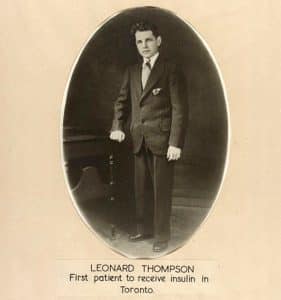
Leonard Thompson, who lived on Pickering Street in the Upper Beach, was the first person to be treated with insulin on Jan. 11, 1922. That was 102 years ago today.
History is a tale full of good and evil, triumph and treachery.
The same week that Banting and Best began their research on May 17, 1921, Mollie’s sister, Anna, vanished in the night, echoed by the missing and murdered Indigenous women of today.
Insulin plays a role in the film’s mystery. What was really in the injections Ernest gave to Mollie who had Type 2 (adult-onset) diabetes, called “sugar diabetes” at the time? She certainly was not one of the first to receive insulin treatments.
Grann makes no mention of Toronto. While the tragic events really did happen in Oklahoma, dialogue is “artistic license” in the film. Ernest was just bragging or lying to his sick wife.
That first year 50 young patients at Toronto General Hospital were treated with insulin. Families from around North America were desperate to help their children. By the end of 1922 insulin was becoming more widely available and Mollie may have received some treatment, but she was not improving. By 1925 Mollie realized she wasn’t dying of diabetes. She was being poisoned. The book and film leave it to us to decide whether Ernest loved Mollie or was trying to harm her.
DiCaprio asked Scorsese, “Where’s the heart of this movie?”
The director agreed that Mollie is the spirit and soul of the film, the conscience that embodies generations of Indigenous pain and exploitation.
Killers of the Flower Moon is an important history lesson in the treatment of Indigenous people. Greed and racism brought out the worst in humanity, while Banting and Best helped save millions around the world, including our “Miracle Boy” from the Beach.
Jan. 23 is the anniversary of a life-changing day for Leonard. The Academy Award nominations come out that same date. I hope to see Lily Gladstone win an Oscar for her portrayal of Mollie and possibly Canada’s own Tantoo Cardinal for playing her mother.
It would be fitting if the late, great Robbie Robertson (who grew up in the Cliffside area of Scarborough) wins for Best Original Score. These three Indigenous artists richly deserve to be honoured, especially at this time of truth and reconciliation.
“Acting allows me to present a different kind of truth, to bring some light back into the stories of our history.”
— Tantoo Cardinal.



Comments (0)
There are no comments on this article.