Protection from off-leash dogs sought for natural area at west end of Woodbine Beach

By ALAN SHACKLETON
Local residents looking to protect an area at the far west end of Woodbine Beach that has become home to nesting and migrating birds are finding themselves in conflict with some dog owners.
The situation escalated recently when one of the people trying to protect the birds from dogs that are let off leash and then run through the area said he was assaulted by a dog owner.
The victim of the reported assault does not want to be identified due to fear of the dog owner(s).
“I now fear visiting Ashbridges Bay Park and Woodbine Beach. Unacceptable!” said the victim in a note to Beach Metro Community News last week.
“Some off-leash dog owners are verbally abusive and sometimes physically threaten anyone who challenges their unlawful behaviour in a public park,” said the victim’s note. “Myself and many of my friends fear them.
“Some dog owners continue on a daily basis to deliberately let their dogs chase and harm wildlife on Woodbine Beach. These people are repeat offenders, they know full well what they are doing. Hunting.”
Toronto police confirmed to Beach Metro Community News last week that the assault had been reported to them. Police added that the investigation is now concluded because the “complainant did not want to proceed further”.
The area is question is at the far west end of Woodbine Beach close to Ashbridges Bay Park. In an earlier Beach Metro Community News story, the area was identified as being home to a wide variety of flora and fauna, some of it very rare, and as a developing site for birds such as plovers to nest and other migratory birds to use as a rest stop.
Local environmentalists and birdwatchers refer to the area as the Dune and Meadow Habitat and are calling for the City of Toronto and the Toronto Region Conservation Authority (TRCA) to designate and protect the area.
In particular, they want to see the city enforce its existing bylaws that prohibit any dogs on the beaches of Woodbine, Kew and Balmy between March 31 and Nov. 1 and also prohibit unleased dogs on the beaches at all times unless in a designated off-leash area.
The city has been working on improving signage regarding the rules for dog owners in the area, and has stepped up the presence of bylaw officers.
“Under the Parks Bylaw (Municipal Code, Chapter 608) dogs are permitted off-leash south of the snow fence line at Woodbine Beach between Nov. 1 and March 31 inclusively. From April 1–Oct. 31 dogs are not allowed on the beach based on the Blue Flag Beach regulations. However, residents may walk their dogs on the parkland and the boardwalk provided they remain on a leash. Signage is posted on site to reflect the bylaw,” said the city in response to questions from Beach Metro Community News.
“Residents can report a dog off-leash by contacting 311. Bylaw enforcement officers respond to complaints made through 311 and proactively patrol the 1500+ parks in Toronto to educate the public about the Parks Bylaw. The City monitors the volume of complaints and then deploys bylaw enforcement officers based on a priority response model that takes into account the frequency and persistence of complaints and issues in parks. The goal is to resolve issues and ensure that residents are following the bylaw. Each issue is addressed on case-by-case basis to make sure reasonable, fair and appropriate actions are taken.”
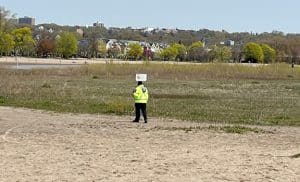
Last Wednesday, May 10, morning, Beach Metro Community News saw a city bylaw officer walking the area at the west end of Woodbine Beach and he told the owner of a small dog running free that it needed to be leashed and not on the beach.
Beyond the direct threat to nesting and migratory birds from unleashed dogs running through the area, environmentalists are looking for long term plans and solutions to protect the Dune and Meadow Habitat area. They said the birds and their nests in the area are designated and protected under the federal Migratory Birds Convention Act.
“It is the responsibility of the manager of the park, City of Toronto, to protect these birds and their nests from offenders who wish to harm them. If the city is unable to protect these birds then please refer to the owners of the land, TRCA, for assistance,” they said.
In a response sent to questions from Beach Metro Community News, the TRCA pointed out it does not manage the lands in question or have the authority to “designate these lands outside of our flooding and erosion mandate”.
The TRCA works closely with the City of Toronto and provides science-based information and knowledge to support sound decision making, said Ralph Toninger, Associate Director Restoration and Resource Management for TRCA.
He said the TRCA is aware of natural features along Toronto’s waterfront including the one at the west end of Woodbine Beach. However, the TRCA does not regulate or officially designate areas as dune or meadow habitats.
“All natural features along the waterfront contribute in some way to the ecological health of our region. Managing waterfront parks and natural areas is a delicate balance between the natural and cultural environments,” said Toninger.
“TRCA has worked successfully with the City of Toronto, as well as our provincial and federal partners, to help direct funding and resources to help improve natural areas and habitat for wildlife in other more significant areas of the waterfront. TRCA does not have a mechanism to protect this area (on Woodbine Beach).”
Toninger said the TRCA does encourage dog walkers to keep their dogs on leash outside of designated off-leash areas but concerns about those who do not should be addressed to the City of Toronto.
“TRCA also encourages park uses everywhere to stay on official trails to avoid trampling vegetation,” he said.
Toninger has provided Beach Metro Community News with a bit of the history on how the area developing at the west end of Woodbine Beach has come to be.
“Prior to 2017 and 2019 record setting high water level events, this area was manicured beach. Since that time, the City has undertaken shoreline restoration, dune creation, flood control work at the Eastern beaches and supported naturalization of this area,” he said. “They have also improved beach safety and are undertaking major works to support water quality improvements. These have collectively improved the area culturally and ecologically since 2017.”