Bike-lane debate comes full cycle
Doing the Macarena, snapping up shares of Bre-X and dot-com companies, touting the primacy of palm pilots and DVDs while bracing for Y2K: It all once made so much sense, till it didn’t – much like protesting new bike lanes.
In the 1990s, I commuted by car from a Beach-area home to downtown jobs, and why not? I had access to free parking and the thought of having to rely on the streetcar was more than I could bear.
So it shouldn’t surprise you that I once was “one of those”, predicting the worst should cycling activists win their fight to have bike lanes installed on Dundas, between Broadview and Kingston Road. Looking back, I’ve had to laugh at myself, especially since becoming a year-round bike commuter on those very lanes over the past six years.
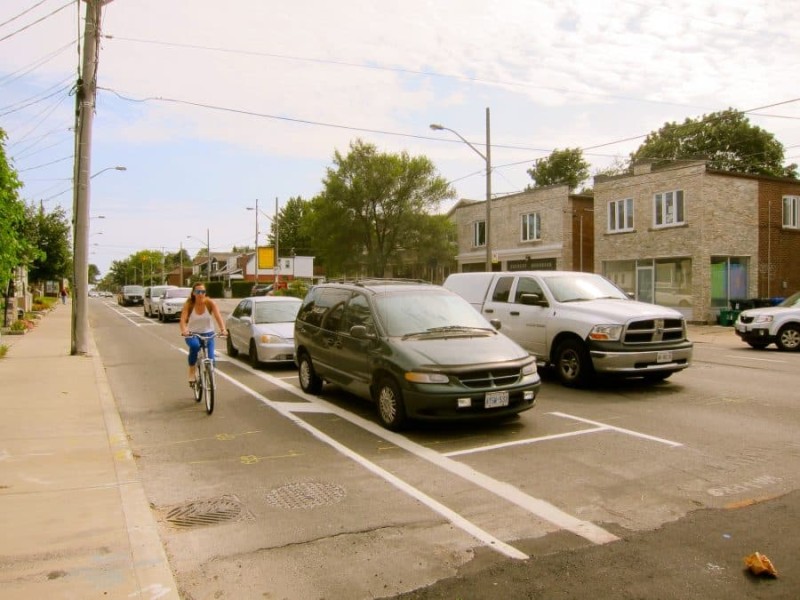
The Dundas bike-lane idea surfaced in earnest in the late 1990s and became reality in 2003 after intense debate. Reread the media coverage from that era and you’ll be struck by how opponents’ arguments are indistinguishable from the ones now being made regarding new bike lanes on Woodbine, between Queen and O’Connor.
Then as now, amplified by alarmist headlines, the gist is that traffic will become a nightmare, prompting drivers to spill into and speed on residential streets, endangering kids.
Congestion already is a nightmare for the car-dependent (and for those trying to run transit systems). It always will be as long as the city remains a magnet. Widening roads only makes things worse in the mid-to-medium term. We’ve proved repeatedly that peak-hour traffic always fills, or slightly overloads, available road space – especially if it’s free. It happens whether or not bike lanes are added to the mix.
Reckless and negligent drivers on side streets are already creating big danger all over (including on the street where I now live, near Danforth and Coxwell, nowhere near any bike lanes). Frustrated drivers who are willing to endanger kids on your street are criminals, even if the law still treats speeding largely as a peccadillo. It’s a crime of opportunity and the criminals’ potential presence highlights the need for more speed humps and turn restrictions, especially since police will never have the resources to properly enforce such essential laws.
It’s true that the Bloor bike-lane pilot project has forced the city to address perceived and possibly real concerns about traffic spilling into side streets in the west end’s Seaton Village neighbourhood.
There will undoubtedly be an adjustment period near Woodbine (last week, Ward 32 Councillor Mary-Margaret McMahon told Metroland that there could be “tweaks”), but it’s not a reasonable argument for denying safe options to cyclists and, more important, would-be cyclists who could be leaving cars at home, freeing up space on roads and in overloaded subway cars.
A long-time resident of a street near Greenwood Park told me a few years back that she erroneously feared the Dundas lane proposal while raising kids. Now, as an empty nester, she has a bike and has come to see the lanes as “a civilizing influence in Leslieville.”
Surprisingly – as someone who still sometimes drives in the city – I’ve found Dundas a better thoroughfare with bike lanes, even when I’m in my car. Travel-time increases (and I once kept detailed records) turned out to be insignificant, while the left-turn lanes added along with bike infrastructure have reduced the need for drivers to constantly switch lanes.
Note that on Woodbine, long-overdue left-turn lanes are being added as part of the cycle-lane project.
I’ve heard complaints that existing bike lanes on Dundas and across the city aren’t being used enough, but that says more about the overwhelming abundance of destinations still beyond Toronto’s piddling bike-infrastructure offerings; cities the world over, including many that get real winter, have shown bike-lane usage grows exponentially the more the lanes create a true network.
Woodbine’s lanes (along with access created by changes at Corley and Norway) will give residents from deep in eastern East York and the old city’s East End access to the Dundas route right into the core, where, admittedly, a shortage of bike parking is a burgeoning problem (even sometimes when the weather’s not that nice).
Woodbine was never the ideal; most cyclists would prefer to ride quieter north-south side streets. Alas, in our area, none of them cross GO’s rail corridor. Even the major streets that do are few and far between. Coxwell, the only other option, has streetcar tracks that left the city little choice.
Potential cyclists fearful of Woodbine’s hill might be amazed how quickly their legs, lungs and outlook strengthen.
There will be reduced car parking on some stretches, but increases north of Danforth, where the project is part of an attempt to revitalize retail spaces that suffered for decades as cars sped past. More opportunities to lock up bikes should make it easier for residents to make use of main streets for more than transportation.
There will be an adjustment period, tweaks may be needed, and the traffic-evaporation process may take months, but the world’s most livable cities are all moving in this direction for good reason.
As Brian Ashton, former councillor for Ward 36 (Scarborough Southwest) and once a prominent critic of the Dundas lanes, told me recently via Twitter message: “Time changes all things. Bikes as a mode of transportation have increased dramatically. Safety has become paramount in sharing of limited public space. Even Henry Ford would promote bike lanes today!”
This column is part of a recurring series tackling urban issues through an east-end lens. Connect with Stephen Wickens on Twitter @StephenWickens1.