Brainstorming a Queen revival
New ideas got free reign at a recent workshop on reviving business in the Beach.
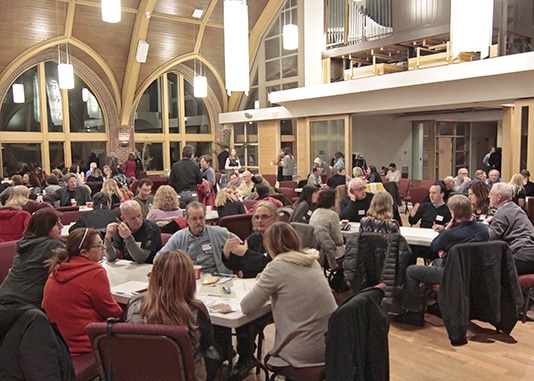
Beach business owners and local residents brainstorm ideas for reviving empty and struggling stores on at a Queen Street revival meeting on Feb. 4.
PHOTO: Andrew Hudson
Cash mobs, pop-up shops, old-school store signs, art shows outside the R.C. Harris water plant – these were just a few ideas raised by the 100 Beachers and Beach business owners who joined the Queen Street Revival workshop held last Wednesday in Beach United Church.
“You call it a revival and have it in a church and look what happens,” said local city councillor Mary-Margaret McMahon, who co-hosted the event with the Beach Village BIA.
One of the biggest challenges facing Queen Street was mapped out on the church’s back wall. Red stickers highlighted roughly two dozen vacant storefronts along the 23-block stretch of Queen Street covered by the Beach Village BIA.
“A number of businesses are closing,” said Marg Gillespie, one of the BIA’s eight volunteer board members.
“There’s a lack of diversity among the ones that we have here. We’ve got lots of people saying they’d like different restaurants, and then different restaurants come in and they close.”
Edward Birnbaum, McMahon’s executive assistant, said roughly seven or eight per cent of Beach storefronts are vacant right now.
Although winter is particularly slow for Beach businesses and vacancies are higher in other parts of the ward, such as Danforth Avenue, Birnbaum said the current rate is still noticeably high.
As for likely causes, Birnbaum said Beach business owners frequently mention rent hikes and high property taxes.
Unlike homes, Ontario has no laws to limit rent hikes on commercial property. While the city is working to reduce its commercial property tax, it is still the highest in the GTA.
Birnbaum also mentioned two Beach-specific bylaws that may be holding back business.
Following a sudden rise in liquor-license applications, bylaws were passed in the 1980s to keep the Beach’s licensed bars and restaurants smaller than in other parts of Toronto.
That rule recently dissuaded owners of La Carnita restaurant from opening in the Beach. A similar restriction on local sidewalk and sidestreet patios has meant years-long application battles and refusals to places like Yogurty’s, which closed its Beach location last year.
Parking is another hot topic, said Birnbaum, noting that the city’s parking authority set aside $3 million for more Beach spaces after a supply study last fall.
More parking could help big retailers such as grocery and furniture stores, he added, though he also mentioned recent studies showing cyclists and pedestrians actually spend more than drivers in shops selling smaller goods.
For some inspired tips on business boosting, the Beach Village BIA invited two guest speakers from nearby community groups – DECA, which works in the East Danforth area, and the Beach Hill Neighbourhood Association, which works along Gerrard Street near Woodbine Avenue.
DECA’s Tina Scherz said nearly one in five of East Danforth storefronts were empty when the neighbourhood group started seven years ago.
Beginning with a local farmers’ market, arts fair and holiday events to drive up foot traffic, Scherz said DECA turned to pop-up shops – temporary stores that landlords allow into a vacant space in return for some cleaning and light renovations.
Of the 25 pop-ups DECA helped launch since 2012, four are now permanent.
Scherz said pop-up shops can’t take all the credit, but commercial vacancies on East Danforth have now dropped to nine per cent. The lesson isn’t necessarily to start a pop-up campaign, she added, but something broader.
“Don’t be afraid to experiment,” she said.
Kate Tennier, chair of the BHNA, pointed out that Beach Hill has just a tenth of the total number of Beach businesses.
Still, Tennier said after three years of successful streetscaping projects and community events, the BHNA has found a unique way to spur local business and community pride by getting residents involved alongside business owners.
“I really think it’s time for us residents to stop kvetching, and just say that we have to be as much of the solution on Queen Street as the BIA,” she said.
“I mean not just to shop – actually doing something.”