Learning from a dog’s illness
“She kept giving us kisses, and that’s how I knew she was the one.”
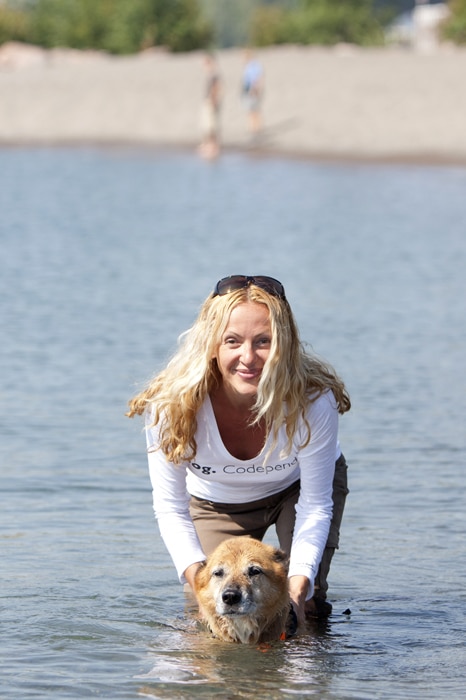
PHOTO: Phil Lameira
That is how Beach resident Tatiana Santini explains how she and her daughter picked Lexie from a litter of puppies in Arizona almost 11 years ago.
Lexie, an American Dingo and Shepherd cross, was soon staying with Santini who “confiscated” her from her daughter, she explained with a smirk.
Last year Lexie slipped on the ice and hurt one of her knees. After extensive treatment, Lexie’s other knee started acting up.
“I thought it was related to her fall, but after an MRI the vet found that the spine was good and her knees were good, and that it was a genetic neurological problem that was affecting her walking,” said Santini.
Lexie was diagnosed with Canine degenerative myelopathy, a progressive disease that causes paralysis starting with the rear legs. It is not curable, and the paralysis moves forward, eventually affecting the lungs and the respiratory system causing death.
The bad news came in May, and although Lexie was still able to walk at the time, by August her hind legs gave out completely.
“I called the vet crying because I thought I was going to have to put her to sleep,” said Santini.
Lexie’s veterinarian suggested using a wheelchair to help her move around. Santini was open to the idea, and quickly found that she could still do normal things with her dog that she would otherwise not be able to, such as taking her to the beach.
“It was difficult at first, but I found that feeling guilty about it wasn’t useful,” said Santini, explaining that she felt that maybe she did not walk Lexie enough, or did not spend enough time with her because of her busy career.
“I learned about self-compassion, and to accept that it was not my fault,” she said. “The only thing I can do is to make the best days of what we have [left].”
The wheelchair attracts a lot of attention from other dog owners and passers-by, and trips home are often lengthened by taking the time to answer questions. She also gets manypositive comments for the fact that she did not give up on Lexie.
“Some people may think that this is not fair to my dog, but I just want to give her a happy life,” said Santini.
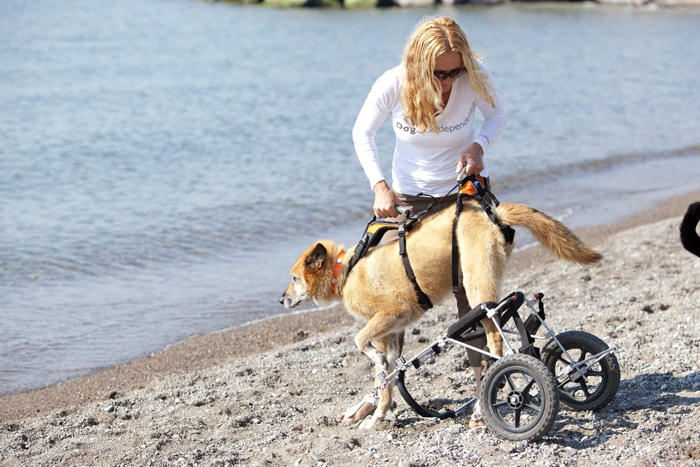
Tatiana Santini helps her dog Lexie out of her canine wheelchair to take a swim in Lake Ontario. Though Lexie suffers from a degenerative neurological disease, she still enjoys swimming, and treats every visit to the beach with the same enthusiasm as her first. PHOTO: Phil Lameira
And although Lexie’s condition has deteriorated, her spirits and joyfulness have not and she continues to exhibit her usual sense of humour and will to play all the time.
“Lexie was always happy. She would come to the same beach and act as if it were the first time she was at the beach,” said Santini, who believes Lexie lives sort of a ‘Zen’ life which in turn has impacted her own life.
Santini is hoping to teach others to apply self-compassion to themselves and also wants to open a shelter for people with pets.
“People with mental issues have a hard time getting into shelters if they have dogs, because they are not allowed. I would like to open a place someday that would allow people with mental difficulties to have a place to stay with their dogs,” explained Santini.
Santini says she will always remember Lexie’s sense of humour and the unconditional love her dog always gave her for almost 11 years. “The feeling of safety and always having that feeling that I am protected. [But] most of all her loving nurturing kind spirit which made me want to live.”